Motorslice
Published on: May 14, 2026

Verdict: 1/5
Clunky, rigid, and often unresponsive mechanics let this title down along with a limited variety of enemies, a lack of story and a weird, semi-sexualised focus on its lead character and her drone.
This is an indie title that either needs a lot of polish or is best avoided, and ultimately left me relieved that the experience was over when I was eventually done.
I hate to admit it, but the social media marketing worked. I’d never even heard of Motorslice until two days before launch on XBOX because clips started popping up on Tiktok and Instagram, all focused on the main character parrying everything in sight, and if you know me, I love a good parry mechanic!
However, for a game that promises “brutal, fast-paced combat", this is VERY much a puzzle platformer, not an action game! Motorslice also leans heavily on talent of Kira Buckland (2B from NieR:Automata) to carry the story, except there isn’t any story to carry in the first place.
So… what went wrong?
Let’s start with the “brutal, fast-paced combat”… there isn’t any.

There are three enemies and only one actually tries to hit you: an excavator. Even then, it’s trivial just mash buttons to parry, or better yet, jump attack and it becomes completely defenceless. What should feel like a threat ends up as little more than an inconvenience.
Next up: the tentacle drone. It fires a one-hit-kill saw blade… which you can parry straight back for an instant kill. So, that’s two out of three enemies you can delete in a single hit. Riveting.
Surely the third enemy shakes things up? Nope. It’s a bulldozer you bait it into charging, step aside, and, you guessed it, one-hit kill.
Then there are the bosses. On paper, this should be where the “fast-paced combat” finally comes into play. In reality, they’re slow, “Shadow of the Colossus” style giants that offer little resistance while you climb them and chip away at weak points. One boss (looking at you Rig) I could stun, which would give me time to clib on and do my thing before it recovered. However, I discovered that I could climb on it and just stand there with no threat. It never tried to get up until I jumped off of it - at least the colossi fought back.
Then there’s the protagonist, P. Voiced by Kira Buckland, it's a casting choice that suggests a degree of depth and personality. In practice though, the limited narrative leaves little room for that performance to develop and much of the delivery settles into a fairly uniform sleepy, snarky, deadpan tone.
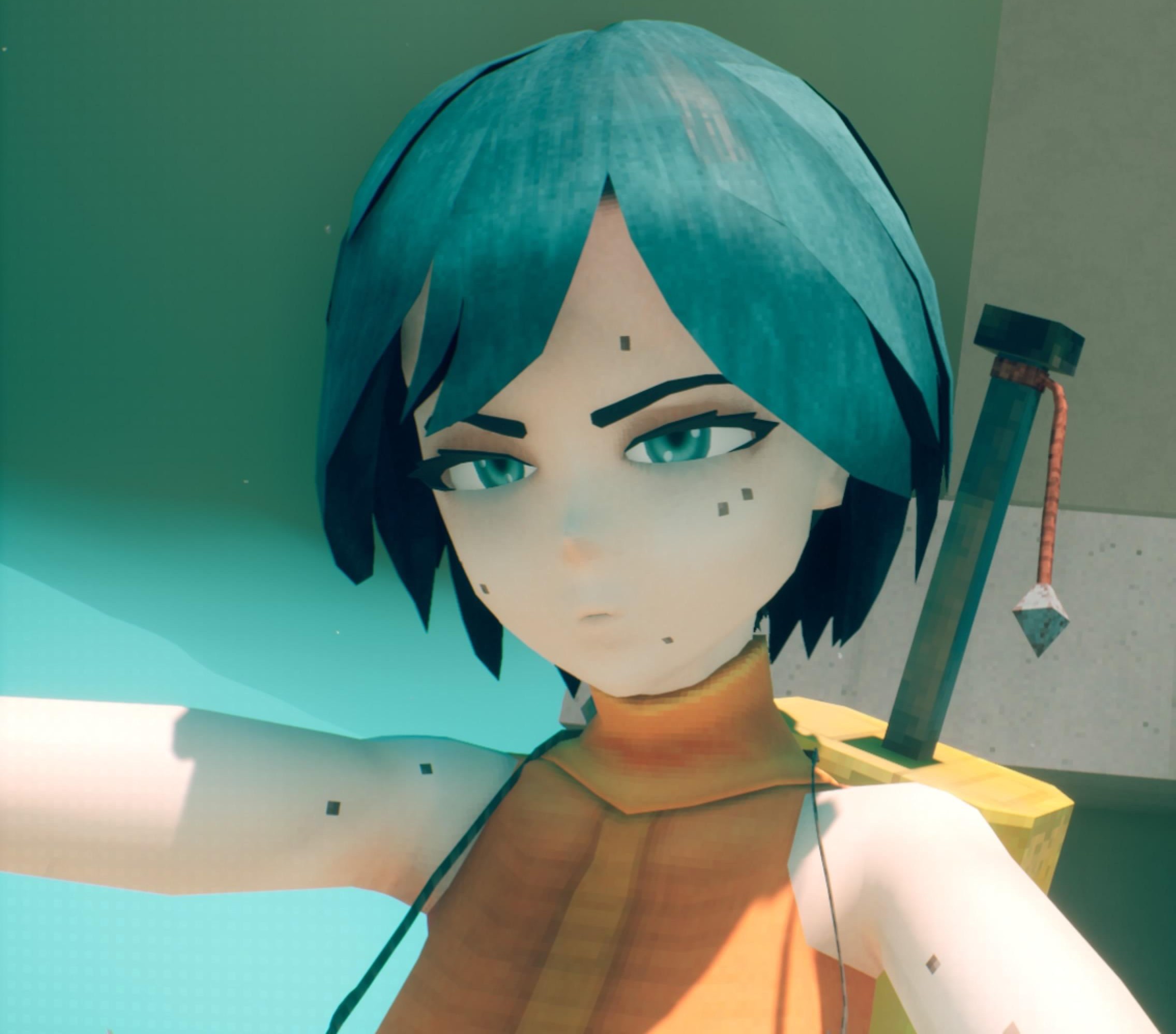
P is also accompanied by Orbie, a drone that doubles as both camera and in-game companion.
Some of the interactions between the two lean into a more playful or irreverent tone, frequently drifting into suggestive territory. There are moments involving camera angles, character reactions, and interactions that feel tonally at odds with the rest of the experience.
Individually, these elements might come across as quirky or stylised but, taken together, they can feel somewhat unfocused and, at times, a little uncomfortable. As the game goes on, it becomes clearer that these interactions are designed with a specific audience in mind, which may not align with every player’s expectations.

One of the more interesting ideas is the decision to position the player as Orbie. Early on, this feels like a neat layer of immersion, giving P’s dialogue a more direct connection to the player. However, as the tone of those interactions becomes clearer, that same choice can take on a different quality, as P’s responses begin to feel less like character-driven exchanges and more like something directed explicitly at the player themselves.
This feels like it's intentionally playing into humiliation kinks and, for a certain audience, this is probably exactly what it achieves.
For example was titled "Holes" 🤨

I didn't like it and I didn't like the puzzle-platforming either. As mentioned, the controls are clunky and unresponsive and one of the core movement/boss combat mechanics, the motorslice, becomes frustrating very quickly.
Let’s start with signposting, the subtle design language developers use to guide players without explicitly telling them where to go. Whether it’s lighting, environmental cues, or the now-infamous “yellow paint”, most games provide some form of visual direction. Motorslice, however, offers very little in this regard and it’s not entirely clear whether that’s intentional.
There were numerous occasions where I found myself exploring areas that ultimately led nowhere. Part of me initially assumed this was by design. The megastructure you climb has a distinctly liminal quality: uniform in colour, sparse in detail, and largely devoid of distinguishing features. In theory, that could create a strong sense of atmosphere.
In practice, though, it often makes navigation feel aimless rather than intriguing. Large spaces lack points of interest, secrets, or meaningful visual cues, which means reaching a dead end rarely feels rewarding, just disorienting. More often than not, it leads to backtracking and trial-and-error pathfinding. That issue is compounded by the movement system.
Wall running, for example, feels inconsistent. Approaching a surface at a shallow angle might result in a lateral run, a vertical climb, or no response at all. The outcome rarely feels predictable, which makes traversal less about mastery and more about chance.

Similarly, momentum doesn’t always behave as expected. There are moments where jumps that appear easily achievable instead end in an abrupt loss of forward movement, as if colliding with an invisible barrier. The result is a lack of trust in the movement system, which undermines confidence in platforming decisions.
Falling introduces further inconsistency. Drops that seem identical can produce completely different outcomes - one landing without issue, the next resulting in instant death. Even the roll mechanic, intended to mitigate fall damage from certain height, can feel unreliable when combined with narrow landing areas, where minor misalignment leads to repeated failure.
Then there’s the Motorslice mechanic itself. Certain yellow-highlighted surfaces allow for rapid horizontal and vertical traversal, and these also serve as damage zones during boss encounters. Conceptually, it’s one of the more interesting ideas in the game.
In execution, however, camera behaviour often works against it. The forced perspective behind the character can obscure upcoming paths, particularly during boss sequences, making it difficult to anticipate movement and increasing the likelihood of avoidable falls.

And finally, the “collectibles”.
These take the form of orphaned Orbies left behind by other slicers, typically placed in hard-to-reach areas. In theory, this should add some optional challenge, but in practice, it just amplifies the frustration of already inconsistent platforming.
It didn’t help that if you collect one and then die, it resets to its original position. Any sense of progress quickly disappears, making repeated attempts feel more tedious than rewarding.
There are achievements tied to rescuing them, which initially gave me a reason to engage. After collecting around 30, that motivation just drops off. With no meaningful feedback, reward, or clear incentive to continue, it became easy to ignore the rest entirely.
By the end, I was skipping them without a second thought. Even if there is a reward further down the line, the experience never did enough to make it worth pursuing.
Overall, I was glad when the experience was over. Due to the wonky achievement scores, 89g and 14g for example, I had to reach the full 1000G and managed it in a single playthrough, which, more than anything, summed up the lack of depth across the whole game.
Ultimately unfulfilling, this title is one of endurance rather than enjoyment. It lacks direction and story, but has a very distinct PS2 era style while controling like an early N64 title. I still believe this is a passion project for the developers, but the content focusing on the odd sexualisation of the protagonist throughout the game and lack of any story makes me heavily question what that "passion" is...

I rest my case.